
Photovoltaic
Frequently Asked Questions
The Special Program covers the entire country. The maximum capacity of PV systems per installation is set at 6 kWp for the mainland, the islands that are Interconnected with the mainland System and Crete, and 3 kWp for the other Non-Interconnected Islands.
According to Ministerial Decision ΥΠΕΝ/ΔΑΠΕΕΚ/121501/5015, fixed PV systems can be installed on building structures used as residences, i.e., on the rooftop or roof of a building, including pergolas, facades, and sunshades as defined in Articles 16 and 19 of Law 4067/12, as in force, as well as on auxiliary areas of the building, such as storage rooms and parking spaces, as defined in paragraph 96 of Article 2 of the same law.
The above installation is permitted as long as it does not conflict with the provisions of the New Building Regulation (NOK) and any specific building regulations in effect for the area.
Auxiliary areas must be located within the same plot as the main building; otherwise, they cannot be classified as such.
It is clarified that the PV system can be installed in any of the above-mentioned spaces or a combination thereof.
Additionally, the installation of PV systems on the ground (e.g., in an uncovered area of the plot) is permitted, provided they are mounted on fixed bases or solar tracking systems (trackers).
Individuals who are not engaged in business activity and who either own or lawfully use (e.g., through lease, free concession, etc.) the building and have the written consent of the property owner where the PV system will be installed, and use the building as their residence, are eligible for the program.
In the case of a PV system installed in a shared or co-owned area of the building, one or more PV systems may be installed. In this case, the right to participate in the program lies with the owners of the horizontal properties, represented either by the building manager or by one of the owners, provided they have obtained permission to use the shared or co-owned space from the other co-owners. Unanimous agreement of all co-owners is required, demonstrated through minutes of a unanimous general assembly decision or written consent, with responsibility falling on the applicant.
There must be an active Low Voltage electricity supply in the name of the PV system owner (individual) at the building where the system is installed.
Additionally, a portion of the building’s thermal needs for hot water must be covered by renewable energy sources (e.g., solar water heater, solar thermal systems, etc.).
The PV system installation project must not be part of any other funding program (e.g., under an NSRF operational program).
The applicant must inform HEDNO of their intention to install the PV system electronically via HEDNO’s appropriate information system by submitting a request along with the required documentation as outlined in HEDNO’s application form.
The applicant must have selected the equipment type and completed the relevant technical study.
HEDNO’s responsible Regional Office evaluates the possibility of connecting the PV system within fifteen (15) days from the request submission date. If approved, a Connection Agreement is sent electronically, detailing the connection cost, necessary works, and timeline. If rejected, written reasons for the rejection are provided.
If approved, the reservation of electricity capacity starts from the date the Connection Agreement is sent.
The interested party is required, within sixty (60) days from the date the Connection Agreement is sent, to pay the corresponding fee, sign the Connection Agreement, and send it online to the competent HEDNO Area Office. Otherwise, after the lapse of sixty (60) days, the reservation of the electrical capacity is automatically revoked, and the proposed Connection Agreement becomes null and void.
From the date of signing the Connection Agreement, the Producer is obliged to activate the connection of the PV system to the Network within twelve (12) months, provided that no works are required at High Voltage/Medium Voltage Substations, or within twenty-four (24) months if such works are required at High Voltage/Medium Voltage Substations.
- €400 + VAT for PV systems up to 5 kWp.
- €500 + VAT for PV systems exceeding 5 kWp and up to 6 kWp if no replacement of supply cable is required.
- €800 + VAT for PV systems exceeding 5 kWp and up to 6 kWp if supply cable replacement is required.
These are standard connection costs, provided that no new network works are required beyond possible cable replacement.
HEDNO completes the construction of the connection works within thirty (30) days, provided that no new Network works are required, or within four (4) months if new Network works are required, starting from the date the Connection Agreement is signed by the applicant.
After the signing of the Connection Contract, the PV system operator submits an application for the signing of a Netting Contract from the PV system operator to the Supplier with whom it has a Supply Contract as a consumer. The procedure is usually completed within 15 days from the date of receipt of the request.
The connection of the PV system is activated by HEDNO’s competent Regional Office within fifteen (15) days from the date of submission of the Readiness Declaration/Activation Request, accompanied by the relevant supporting documents required for this stage, provided that HEDNO has completed all necessary works (e.g., construction of any connection works and performance of required installation checks for safe network connection).
The applicant may submit a Readiness Declaration under Article 4A of Law 4414/2016 (Official Gazette A’149), as in force, if they have completed all installation works of the PV system, providing the required supporting documents for this stage, in order to secure the reference price in Table 1 of paragraph 1(b) of Article 4 of Law 4414/2016, as in force.
The Readiness Declaration may be submitted either simultaneously with or prior to the Activation Request
The PV system is connected to the Low Voltage network using the same supply cable through which the building’s consumption is supplied, according to the following diagram. An electronic meter is installed for the PV system, while the existing consumption meter (if electromechanical) is replaced with an electronic one.
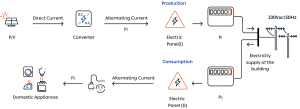
In this way, the measurement of energy generated by the PV system and the measurement of energy consumed by the installation are correlated and essentially form a unified whole. For this reason, the connection corresponds to the existing supply number of the PV system owner’s property.
The metering of the energy produced by the PV system is carried out simultaneously with the metering of the energy consumed, i.e. the same metering cycle is applied as for the energy consumed.
However, payment for the energy produced is made on the clearing electricity bill (and not on the netting bill).
In the event that for any reason it is not possible to obtain the readings on the date of the scheduled count, the clearing shall take place as soon as the next regular count is carried out.
The credit from the PV system energy produced appears in the PV system owner’s electricity bill. Essentially, the electricity bill takes the place of a purchase invoice.
This amount of credit is netted against the charges arising from the Electricity Supply Contract. In case the total electricity bill is a credit, then the amount shall be credited to the bank account of the PV System Operator on the due date of the electricity bill.
The Netting Contract signed between the Supplier and the PV system owner has a validity period of twenty (20) years, starting from the date of activation of the PV system connection.
The Netting Contract shall be terminated
- automatically at the end of the 20-year period.
- automatically in the event of a change of Supplier. In this case, a new Netting Contract shall be concluded for the remaining 20-year period with the new Supplier.
- automatically upon termination of the Supply Contract or the Connection Contract.
- upon termination by the Supplier, in the event of the PV System Operator’s failure to comply with the terms of the Netting Contract, upon written notice to the Supplier, in order for the other party to comply with its obligations (recovery period) and after the expiry of a 15-day period.
- upon termination by the owner of the PV system without good cause, upon submission of a written request and within 15 days of service of the request.
- after a complaint by the PV system owner, in case of a permanent shutdown of the PV system.
In the event of a change in the owner of the PV system due to the transfer of the relevant ownership of the building where the PV system is installed, the new owner automatically assumes the rights and obligations of the transferor arising from the Netting Contract.
Changes to the type or manufacturer of panels and inverters are accepted, upon written notification to HEDNO’s competent Regional Office, attaching the corresponding technical manuals and certificates, provided that the new sizing does not change the total installed capacity (kWp) of the system by more than 3% from the originally declared value, and does not exceed the maximum power limit defined by the Ministerial Decision.
- Power increase applications submitted before the signing of the initial Connection Agreement are treated as new applications and are reviewed in the order they are submitted. A new Connection Agreement is sent for the new total capacity, provided there is available electrical capacity.
- Power increase applications submitted after the Connection Agreement is signed are also considered new applications and reviewed in order of submission. A new Connection Agreement is sent for the new total capacity, provided there is available electrical capacity; otherwise, the initial signed Connection Agreement remains in force.
- Power increase applications after activation of the connection are possible upon submission of a new application and signing of a new Connection Agreement, provided there is available electrical capacity.
Natural persons who are not self-employed are allowed to participate in the program as many times as they wish, provided they own or lawfully use the property where the PV system is to be installed and the prerequisites mentioned in question 4 are met.
In the case where the property is jointly owned by more than one co-owner (i.e., there is co-ownership), one of the co-owners may apply for inclusion in the Special Program, but must submit the written consent of the other co-owners.
The minor child cannot apply, but those who exercise parental custody over the minor may do so by submitting a court decision granting them special authorization to request, in the name and on behalf of their minor child, the installation of a PV system, provided all other requirements are met.
On a shared roof that has been granted by a notarial deed the exclusive use of part of the roof to one or more owners of horizontal properties, a PV system can be installed and only one, after the agreement of the co-owners.
The Special Program applies to the installation of PV systems in buildings located in planned areas and settlements, but also in areas outside planned areas, provided that the other conditions are met in each case.
Given that the storage room or parking space constitutes an auxiliary area of the main building, in which there is an active electricity supply (with the supply number to which the PV system is linked), the installation of the PV system is independent of whether or not that auxiliary space has its own electricity supply.
The scope of the Special Program applies to building facilities used for residential purposes. Therefore, PV systems cannot be included in the Program if installed in areas used for other purposes.
The installation of PV systems on buildings is permitted as long as it is done on the rooftop or roof of a lawfully existing building.
The installation of such systems is also permitted on buildings where unauthorized constructions or unauthorized changes of use have been made, for the duration of the retention period, provided the relevant legalization process has been completed.
It is emphasized that the existence of a connection of the building to public utility networks does not in any case constitute a criterion or proof of legality.
According to the provisions of Article 23 of the NBR, a building or part of it is considered to be legally existing if it predates the Royal Decrees of 9.8.1955. The inclusion of a building or part of a building in the above provision is verified by a certificate issued by the competent Building Office, the issue of which may require the submission of a certificate of antiquity from the competent Municipality/Body.
On the same property, it is prohibited to have both a PV system under the Special Program and a production station with net metering or virtual net metering that correspond to the same consumption installation, i.e., the same electricity supply number.
The Installer Electrician Declaration, which is required for the activation of the PV system, as well as the relevant documentation that accompanies it (drawings, description of the anti-islanding method, protection settings, etc.), must be signed by Graduate Electrical Engineers or Certified Electrical Engineers or Engineers of related specializations with the corresponding professional rights, such as Mechanical Engineers, Engineers, etc.
The owner of the PV System, undertakes the following obligations:
To enter into and maintain the Connection Contract and the Supply Contract under their name.
Not to make any changes to the power of the PV system without prior notification of the Network Operator and the Supplier.
Not to interfere with the installation and operation of the PV System, except for necessary maintenance and repair work.
Immediately and thoroughly inform the Supplier of any interruption in the operation of the PV system for a period of more than five (5) days, which is not due to an event of force majeure.
To promptly and diligently inform the Supplier of any matter affecting the smooth performance of the obligations under the Netting Contract.
The installation of PV systems under the Special Program:
- In traditional settlements, historical city areas, and listed buildings is only permitted in uncovered outdoor spaces.
- In areas of outstanding natural beauty is permitted provided it is not prohibited by the relevant environmental protection legislation and that the installation harmonizes, as much as possible, with the surrounding environment.
For the above cases, approval is granted following the consent of the competent Urban and Architectural Control Committee (EP.A.E.).
To install a PV system in an uncovered area of a plot, the following are required: a small-scale construction work approval; a certificate stating that the PV system is exempt from the obligation to issue an Environmental Terms Approval (AEPO); and a document from the competent authority or a Solemn Declaration from an engineer, according to the provisions of Ministerial Decision ΥΠΕΝ/ΔΑΠΕΕΚ/74123/2971 (Official Gazette B’ 3149/30.7.2020), indicating the land classification (e.g., high productivity agricultural land, non-high productivity agricultural land, or land of another type other than agricultural).
In cases where requests for cancellation of the connection of PV system installations are submitted by the interested parties, if the request for cancellation of the connection is submitted after the signing of the Connection Contract and before the construction of works on the supply, part of the amount is refunded in order recover the costs incurred by HEDNO until the stage of cancellation.
In cases where the cancellation request is submitted after the construction of the supply (regardless of whether or not the meter has been installed) the amount paid will not be refunded.
After the online submission of the PV system connection application, all communication (submission/transmission of required documents) between HEDNO and the applicant will take place online.
A document sent via email is considered to have been received by the recipient on the day it was sent, provided that the recipient’s email system recorded its receipt before 3:00 p.m. Otherwise, it is treated as received the day after it was sent.