
Implementation of the net metering system by self-producers
Frequently Asked Questions
Net metering means the netting of the energy entering the Network from a production station with the energy absorbed at the consumption installation of the self-producer. The production station may be installed on the same or adjacent site as the consumption installation. It is permitted to install the station in a location remote from the electrical installation, provided that it is electrically connected via a dedicated interconnection line (Article 59 of Law 4843/2021 (GG 193 A 2021), which shall be part of the internal electrical installation. Based on the existing framework, in net metering the produced energy does not have to be synchronized with the consumed energy.
The terms and conditions for the development of power plants with net metering were established by Ministerial Decision ΑΠΕΗΛ/Α/Φ1/οικ.24461 (GG Β’ 3583/31.12.2014). Subsequently, the initial Ministerial Decision was replaced by Ministerial Decision ΑΠΕΗΛ/Α/Φ1/οικ.175067 (GG Β’ 1547/5.5.2017), which was also replaced by Ministerial Decision ΥΠΕΝ/ΔΑΠΕΕΚ/15084/382 (GG Β’ 759/5.3.2019) and finally amended by Ministerial Decision ΥΠΕΝ/ΔΑΠΕΕΚ/74999/3024 (GG Β’ 3971/30.8.2021) and Ministerial Decision ΥΠΕΝ/ΔΑΠΕΕΚ/121503/5016 (GG Β’ 6287/29.12.2021).
On the mainland and the interconnected islands (including the small Interconnected System of Crete) the capacity of the production station cannot exceed the agreed consumption capacity and maximum capacity limit of 3 MW.
The 3 MW limitation does not apply to stations installed by a legal person of the State or a legal person governed by public or private law pursuing general or local public interest objectives.
Specifically for small wind turbine production stations or station featuring two technologies, one of which is small wind turbines, the total installed capacity small wind turbines may not exceed the maximum of 60 kW.
Stations with net metering are exempted from the obligation to obtain a Producer’s Certificate.
In Crete and in the interconnected islands of the Cyclades (Paros-Naxos complex, Mykonos, Syros, Andros, Tinos), the installation of plants with net metering is permitted until the margins given by par. 1 of Article 132 of Law 4819/2021 as amended by Article 65 of Law 4843/2021.
In the Non-Interconnected Islands (NIIs) the capacity of the production station cannot exceed the agreed consumption capacity and limit in the table below:
|
Autonomous Island System
|
Maximum power limit for stations installed by public or private legal persons pursuing general or local public interest objectives (kW) |
(kW) |
|
Rhodes (Complex) |
500 |
100 |
|
Kos (Complex) |
100 |
50 |
|
Lesvos (Complex) |
100 |
50 |
|
Thira (Complex) |
100 |
50 |
|
Chios (Complex) |
100 |
50 |
|
Samos (Complex) |
100 |
50 |
|
Other Systems |
100 |
20 |
Specifically for small wind turbine production stations or station featuring two technologies, one of which is small wind turbines, the total installed capacity small wind turbines may not exceed the maximum of 60 kW.
Stations with net metering are exempted from the obligation of a Producer’s certificate.
It should be noted that the capacity of production stations with net metering is counted in the respective power margin of each NII power system. The power margin per technology and per power system is determined by RAE Decision 616/2016. The same Decision provides that the margin for photovoltaic production stations is allocated exclusively for stations of the Special Roofs Program and for stations with net metering or virtual net metering (self-producers or Energy Community).
For the stations in Rhodes with an installed capacity exceeding 100 kW and in the rest of the NIIs with a capacity exceeding 50 kW, the rules for integration and operation provided for in the NII Code (Article 206) apply, and therefore the Operator can impose the limitation of the active power output of these stations or even their shutdown. To this end, these production stations shall be equipped with remote monitoring and control equipment in accordance with the requirements of HEDNO.
For the connection of a production station to an existing consumption supply, in addition to the limits set in the Ministerial Decision for the power size of the station, the technical capacity of the consumer’s supply should be taken into account, i.e:
- the capacity of a production station on single-phase supplies may not exceed 5
kW. - the capacity of a station with rotating generators may be limited to a further 100% of the agreed supply capacity, depending on the technology of the generators and way of connection to the Network (generator with power converter, direct coupling or smooth coupling device).
Specifically for PV stations, the maximum power allowed per size of supply in the Interconnected System and in the NII, taking into account both the limitation of the Ministerial Decision and the technical capability of each size of Supply, is presented in the Tables in the Annex.
It should be noted that in the supplies No. 6 and No. 7 the maximum power of a PV station can now be up to 135 kW and 250 kW respectively.
Production stations can feature one of the following technologies: photovoltaic stations (with fixed photovoltaic on buildings or on the ground or with ground-based solar tracking systems), biomass/biofuel plants, biogas plants, small hydroelectric plants, CHP plants and small wind turbine plants. The licensing procedure for the installation of small wind turbines is laid down in Ministerial Decision ΥΠΕΝ/ΔΑΠΕΕΚ/74462/2976 (GG 3150 Β’ 2020). In particular, production stations connected to the MV alone may consist of two of the above technologies.
The right to install the station is granted to natural persons (traders or not), and legal persons under public and private law, who either own space where the station will be installed, or have the legal use of it (e.g. through lease, free concession, etc.) and have secured the written consent of the owner of the space.
In the case of a production station in a shared or jointly owned area of a building, one or more production stations may be installed, each of which is assigned to a single consumption meter. The right to install in this case shall be held by the owners of the horizontal property or by those who have the legal right to use it after the other co-owners have been granted the use of the shared or jointly owned space or part of it. For connection to the provision of shared property, the owners of the horizontal properties shall be represented by the manager. A necessary condition is the agreement of all the co-owners of the building, which must be demonstrated either by a unanimous decision of the general meeting or by a written agreement of all the co-owners of the building.
The basic terms and conditions for the installation of production stations with net metering are as follows:
- The existence of an active permanent power supply in the name of the self-producer through which the consumption installation is powered.1
- The production station is assigned exclusively to a consumption meter, i.e. the meter of the consumption installation it supplies.
- The interested party has the legal use/legal possession of the station site.
- The provision of the self-producer has not been included in the Environmental Residential Tariff (Ministerial Decision ΥΠΕΝ/ΥΠΡΓ/26359/4101 – GG Β’ 1936/30.5.2018). If the person concerned is a beneficiary of this tariff, they are automatically exempted from it upon activation of the production station.
For the sizing of the production station it is appropriate to take into account the annual consumption of the supply to be netted. It is recommended that the annual energy produced by the station should not exceed the annual consumption.
In the Interconnected System and in Crete for PV stations connected to LV consumption facilities, the connection request is submitted to the competent local unit of HEDNO (Region), while for PV stations connected to MV consumption facilities, connection requests are submitted to the headquarters of the competent Region Department of HEDNO. The applications:
• for stations featuring other technologies, irrespective of the level of connection,
• for stations featuring a combination of two technologies, and
• for stations of any technology connected to an MV consumption installation and combined with a storage system over 30kVA
are submitted to the Network Users Department.
In the Non-interconnected Islands, applications for PV stations, regardless of the level of connection, will be submitted to the competent Area of HEDNO. For other technologies, applications will be submitted to the Islands Management Department.
The application must be accompanied by the document and the details indicated in the application form for this stage (template available on the website of HEDNO). A condition is that the relevant technical study has been carried out by a suitably qualified engineer and the type of equipment to be installed has been selected.
Requests for connection will be submitted to the competent host unit (NUD, Region Department, Area) and then the completeness and correctness of the file will be checked. If the file is incomplete, it will be returned to the applicant.
Within the next month following the submission of the application, the competent department of HEDNP (Area/Region/NUD) shall issue a written Final Connection Offer to the applicant, provided that the conditions for issuing a Final Offer as provided for in the application form are met. The offer shall include a description of the works to be carried out by HEDNO for the connection and the total related costs, as well as the works and actions to be undertaken by the applicant for the implementation of the connection. The offer shall be valid for a total period of two (2) months from the date of its issue. Within the aforementioned period, the interested party must submit its acceptance in writing. Any failure to comply with the two-month period will result in the automatic termination of offer of connection.
In particular, for the Non-Interconnected Islands, the Connection Offer will be granted if there is available power margin in the specific electricity system.
The activation of the station must completed within the validity period of the Connection Offer. The validity period of the Connection Offer is defined as:
a) twelve (12) months from the granting, provided that no work is required on the LV/MV Substations
b) twenty-four (24) months from the date of its issuance, if the construction of a new LV/MV Substation or extension of an LV/MV Substation is required.
Specifically for cases where there is an obligation to conduct competitive procedures, in accordance with the provisions for public procurement, in order to implement the project, the validity of the Connection Offer is extended by eighteen (18) months respectively, provided that the operator informs the Operator before the expiry of the Offer.
At the same time as the acceptance of the final offer, the interested party submits an application for the signing of the Connection Contract to the competent unit of HEDNO (Area/Region/NUD), providing the additional documentation required at this stage. The competent unit notifies the interested party of the procedure for payment of the connection fee and signing of the Connection Contract
The costs for connecting PV production stations to Network are presented in Table 1. The costs shown are valid provided that no network project is required for the connection. The costs also include costs of controlling a production meter and the metering transformers, where required. The indicated prices shall be increased by the applicable VAT.
Table 1: Costs of connecting a PV production station with net metering to the grid of HEDN (without new Network project)
| Voltage level connection of the User Installations | Type of supply | PV power production station (kWp) | Connection cost(€) | |
|---|---|---|---|---|
| Without replacement of the existing consumption meter | By replacing the existing consumption meter | |||
| LV | Single-phase (03, 05) | ≤ 5 | 300 | 370 |
| Three-phase | ≤ 55 | 300 | 390 | |
| Three-phase | 55 – 100 | 520 | 520 | |
| Three-phase | 100 – 250 | 800 | 800 | |
| MV | Three-phase | ≤ 100 | 520 | 520 |
| Three-phase | >100 και ≤ 1000 | 800 | 800 | |
| Three-phase | >1000 και ≤ 3000 | 1500 | 1500 | |
After the signing of the Connection Contract, the self-producer shall submit a request to the Supplier, with whom it has concluded a Supply Contract as a consumer, for the signing of an Net Metering Contract. The procedure shall be completed within 15 days from the date of receipt of the request. The date of entry into force of the Net Metering Contract shall be the date of activation of the connection of the production station.
The Net Metering Contract signed between the Supplier and the self-producer has a term of 25 years, starting from the date of activation of the connection of the production station. In the event of a change of Supplier after the activation of the production station, the Net Metering Contract with the previous Supplier shall automatically terminate and a new Net Metering Contract shall be concluded between the self-producer and the new Supplier for the remaining 25-year period. The same applies in the case of transition of an operating PV station that was installed under the Special Program for Developing PV Systems on buildings (GG B’ 1079/2009) to the system of self-production with net metering.
To activate the connection of the production station the following is required:
- The submission of a request of the interested party stating the readiness of their establishment with the relevant supporting documents attached to the request for this stage.
- The completion of the works required by HEDNO, such as replacement of an existing meter, construction of any connection project and carrying out the required checks of the production installation for safe connection to the Network.
The connection of production stations with net metering is made using the existing supply through which the consumption installation is connected. If the installation of a production station is planned to be combined with an augmented consumption capacity exceeding the capacity of the existing supply, the process of augmenting the supply shall precede the request for a production station with net metering.
The implementation of net metering requires the recording of both incoming energy (energy absorbed by the Network) and outgoing energy (energy injected into the Network). To this end, if the existing meter of the consumption installation does not already have this capability, it shall be equipped with a new two-way meter.
Furthermore, the installation of a second meter for measuring the energy produced by the station is required. Specifically for the case when two production technologies are combined for energy production, instead of one meter, two meters are installed.
The production station is not connected to the general LV panel of the installation in the case of LV users, but to a point upstream on the panel (see Figure 1), or to the LV busbar of a new or existing transformer in the case of MV users, in such a way that the general consumption panel is fed at the same time by Network and production station.
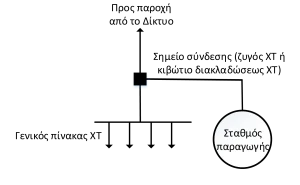
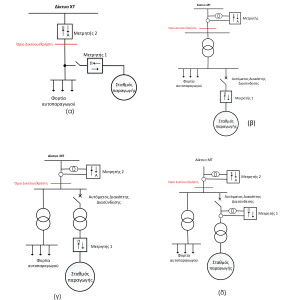
Figure 2 shows the two meters, as well as the boundary of ownership and responsibility between the Network and the customer installation for connections at the HV and MV levels of the Network. Specifically:
Meter 2 is installed in the place of the existing meter of the consumption installation (if the latter does not have the possibility of two-way recording) by HEDNO and belongs the fixed part of the Network.
Meter 1 is installed by the self-producer, which supplies it at their own expense, based on the instructions of HEDNO regarding the accepted types, and is certified before its installation in HEDNO’s lab. Upon activation of the connection, the staff of HEDNO shall check and adjust both meters and seal them. Meter 1 is part of the internal installation and a fixed part of the self-producer.
In cases where the production station is connected to the electrical installation through a new transformer, Meter 1 may be installed alternatively on the MV side of the transformer, via suitable transformers of both voltage and current. Especially in cases where the primary of the the new set-up transformer has voltage other than 400V, the metering of the produced energy must be conducted with a metering device on the MV.
During the operation of a net-metered production station, the energy produced can be used to supply the self-producer’s loads or be injected into the Network. In order for the energy to be used exclusively for the self-producer’s loads and for the station to avoid feeding energy into the Network (‘zero feed-in’), the following setup is typically implemented:
An “energy flow direction sensor” (also referred to as a ‘smart energy meter’), either single-phase or three-phase and with or without a measurement transformer depending on the case, is installed at the point of entry of the installation. The installation and proper operation of the sensor (S) is the responsibility of the self-producer.
When surplus generated energy that would otherwise be exported to the Network ceases—due to insufficient production and/or increased consumption—the sensor signals the station to reduce or halt production so that no energy is injected into the Network (see Figure 3).
Alternative implementations are acceptable, provided they adequately demonstrate and ensure that no energy is injected into the Network from the installation.
The ‘zero feed-in’ configuration allows for the connection of a production station to a saturated network, provided that the saturation is due to exceeding the nominal capacity of network components or surpassing the permissible voltage limits at network nodes. However, if the network is classified as saturated due to exceeding the short-circuit level at the MV busbar of the upstream HV/MV transformer, the implementation of the ‘zero feed-in’ scheme does not make it possible to connect the generation station.
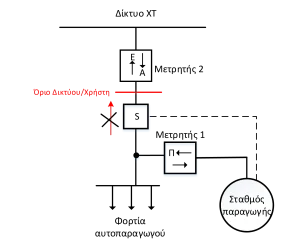
The self-producer who intends to implement the above scheme, on top of the other details and documents, they are also obliged to submit to HEDNO a Technical Description demonstrating compliance with the zero feed-in, accompanied by the manufacturer’s electrical study and technical manual for the production station and the “direction sensor”. In the connection offer and in the Connection Contract, a special condition shall be placed on the obligation not to inject energy into the Network. In addition, the self-producer is bound by a Solemn Declaration according to Law 1599/86 that during the entire period of operation of the installation the management system of the production station will not be modified.
During commissioning of the production station, HEDNO may carry out appropriate tests to verify the non-injection requirement, and during operation, monitor the metering data of the supply in order to detect any violation of the requirement. In case it is found that the above requirement is violated, HEDNO may deactivate the connection of the self-producer to the Network.
The metering of the electricity produced by the production station, as well as the electricity entering and leaving the Network, is carried out simultaneously by HEDNO, based on the existing metering cycle governing the consumption installation of the self-producer.
The Supplier shall carry out the net metering procedure in the clearance electricity bills, based on the metering element of HEDNO in accordance with the metering cycle. In the event that for any reason it is not possible to obtain the readings on the date of the scheduled metering, the netting shall be carried out as soon as the next regular metering is conducted.
The energy clearing shall be carried out by the Supplier with whom the self-producer has contracted, i.e. the Supplier representing the consumption installation, on the basis of the actual metering data provided by the Network Operator. Therefore, energy clearing is carried out on each clearance bill issued by the Supplier, with final clearance on the first clearance bill issued after three years from the activation of the station. The procedure shall be repeated every three years until the expiry of the Net Metering Contract.
The difference between the quantities recorded by Meter 2, i.e. the difference A (Absorbed) – E (Recorded), is considered to be the chargeable energy (for the competitive part of the tariff), if this difference is positive. If the difference equals zero there is no chargeable action, and if the difference is negative there is also no chargeable action, and this difference is credited to the next clearance bill as an additional recorded action. Any surplus remaining after the three-year period has been cleared shall not be credited to the next bill. The above is illustrated, in the form of an example, in the table below for a consumer installation with quarterly metering. Please note that in the case of escalated charges in the consumption bill or a multi-zone tariff, the netting is carried out in such a way that the lowest charges for the self-producer at the level of the respective clearance bill result.
| Έτος | 4μηνο | Απορροφώμενη (Α) | Εγχεόμενη (E) | Συμψηφιζόμενη (Ν=Α-Ε) | Χρεωστέα | Πιστούμενη διαφορά | Παραγόμενη (Π) | Κατανάλωση (Κ=Α+Π-Ε) |
|---|---|---|---|---|---|---|---|---|
| 1ος | Α | 1500 | 900 | 600 | 600 | 0 | 1500 | 2100 |
| 1ος | Β | 700 | 1500 | -800 | 0 | 800 | 2300 | 1500 |
| 1ος | Γ | 1000 | 800 | 200 | 0 | 600 | 1300 | 1500 |
| 2ος | Α | 1200 | 1000 | 200 | 0 | 400 | 1400 | 1600 |
| 2ος | Β | 800 | 1500 | -700 | 0 | 1100 | 2400 | 1700 |
| 2ος | Γ | 1100 | 900 | 200 | 0 | 900 | 1300 | 1500 |
| 3ος | Α | 1300 | 1000 | 300 | 0 | 600 | 1500 | 1800 |
| 3ος | Β | 1000 | 1400 | -400 | 0 | 1000 | 2500 | 2100 |
| 3ος | Γ | 1200 | 900 | 300 | 0 | 700 | 1400 | 1700 |
| ΤΡΙΕΤΙΑ | 9800 | 9900 | -100 | 0 | 0 | 15600 | 15500 | |
The final difference of 100 kWh from the three-year net metering period (since the total annual production of the station was 15,600 kWh and the total actual consumption was 15,500 kWh) is not carried over nor compensated (it is lost for the self-producer).
The regulated charges are calculated as follows:
- The ETMEAR charge is calculated based on the absorbed energy (A) multiplied by the respective unit charge.
- The variable component of the System Use Charge and the Network Use Charge (energy charge) is calculated based on the absorbed energy, multiplied by the respective unit charge.
- The Public Utility Services charge is calculated based on the total consumed energy (K = A + Γ – Ε), multiplied by the respective unit charge.
In the case of a tariff with different time zones (time-of-use pricing), the total produced and injected energy is used only to calculate PUS charges corresponding to normal rate consumption (daytime use).
Yes, changing the type and/or manufacturer of the panels and inverters is permitted, provided that:
- A written notification is submitted to the competent management unit,
- The relevant technical manuals and certifications are attached,
- The notification is submitted no later than the application for connection activation, and
- The new sizing does not alter the total installed capacity (kWp) of the station.
- In such cases, there is no need to amend the Connection and Net Metering Contracts.
- Capacity augmentation applications for stations with a submitted initial application but no issued connection offer are considered new applications and are evaluated based on the submission date of the augmentation request.
- Capacity increase applications for stations with an existing and valid connection offer are also treated as new applications.
These are examined according to the submission date of the augmentation request, and a new connection offer is issued. - Requests for augmentation of the capacity of production stations after the activation of the connection will be possible, at the same level, after a new request, the granting of a new Connection Offer and the payment of the related costs. In such cases, the Connection and Netting Contracts will be amended with regard to the capacity of the production station.
The transition of operating systems installed under the “Special Roofs Program” to the net metering scheme is allowed for the remaining period of time against the 25 years of the originally concluded Netting Contract. The transition requires the submission of a request, a summary of a new Connection Contract and a summary of a new Net Metering Contract with the Supplier. The costs of the transition shall be borne by the party concerned.
No, the coexistence of stations referring to the same consumption meter, i.e. referring to the same supply number, is not permitted. The coexistence of systems under the “Special Roofs Program” or other program and of self-production stations with net metering is permitted in the same area, only if they are assigned to different consumption meters, i.e. different supply numbers.
No, in net metering each production station is assigned exclusively to a consumption meter, i.e. a supply number. Matching with several consumption meters is only possible in the context of virtual net metering.
If the provision is in the name of the usufructuary, the usufructuary without the consent of the bare owner. If it is in the name of the bare owner, the bare owner with consent of the usufructuary. In cases of joint ownership, the owner in whose name the supply is with the written agreement of their joint owners.
The aforementioned Solemn Declaration concerns the entire installation, i.e. both the existing consumption installation, after it has been modified, and the production installation that is integrated into the consumer’s internal electrical installation. This Solemn Declaration and the relevant documentation accompanying it (design, technical report, description of how to avoid islanding, protection arrangements, etc.) shall be signed by an Electrical Engineer or an Engineer of similar specialization with the corresponding professional title (e.g. Mechanical Engineer), in accordance with the provisions of the relevant Ministerial Decision (Article 13, paragraph 6).
Self-producers with net metering must ensure compliance with the provisions of the applicable planning and environmental legislation during the installation of the production station and ensure the issuance of required permits, approvals or other relevant administrative acts, which they will keep. Before the activation of the production station, HEDNO will receive a Solemn Declaration of Law 1599/1986 (a relevant model is posted on its website) from the self-producer and their responsible engineer, with which they will confirm and undertake responsibility for compliance with all relevant provisions.
In accordance with Paragraph 13 of Article 8 of Law 3468/2006 as in force, PV stations installed in a building or other structures or within organized receptors of industrial activities, are exempt from the obligation to issue an Environmental Terms Approval (ETA) decision and the inclusion in standard environmental commitments (SEC) and for the exemption from ETA and SEC no certificate is required.
For the placement of PV stations in a building with power output of up to 100 kW, no building permit or approval of small-scale building works is required. For PV stations with a capacity exceeding 100 kW, approval of small-scale building works and a structural adequacy study of the building on which the installation will be made, signed by a qualified civil engineer, is required.
PV stations with a capacity of less 1 MWp installed on land are exempt from environmental licensing if they are not located in a Natura 2000 network area or in a coastal location less than 100m from the coastline of the shore, except for rocky islets. Otherwise, the stations are classified in Category B in accordance with Ministerial Decision ΥΠΕΝ/ΔΙΠΑ/74463/4562 (GG 3291 Β’ 2020) and are subject to a SEC. In any case, the installation of PV stations on land requires the approval of small-scale building works.
In a three-phase supply, the three-phase configuration of the station connection is mandatory, i.e. connection with a three-phase inverter and a three-phase metering device (Meter 1), even in the case of a :s::5 kW production station installation.
Exceptionally, in three-phase supplies of a group of consumers with spatial proximity, such as supplies belonging to the same apartment building, single-phase configurations of production stations may be accepted provided that the total power of the group is distributed symmetrically over the three phases of the network.
In cases of change of Supplier:
- A final clearance is carried out, i.e. an extraordinary measurement of the energy injected into the Network and the energy absorbed by the Network and a relevant clearance bill is issued.
- There is no obligation to pay any compensation to the self-producer for any surplus of injected energy after the issuance of the clearance bill.
- A new Net Metering Contract is signed for the remaining 25-year period.
The procedure from the application to the connection and operation of a PV station with a capacity exceeding 50kW and other stations over 20kW is summarized in the following steps: Step 1: Submission of a connection request to the Network Operator.
Step 2: If the application file is complete and the information is correct, the Operator will review the request and make a connection offer to the interested party or will reject the application. The offer shall include description and cost of the connection work and shall be valid for period of two (2) months from the date of issuance. Within the aforementioned period, the interested party must submit its acceptance in writing. Any failure to comply with the two-month period will result in the automatic termination of offer of connection.
In accordance with Ministerial Decision ΥΠΕΝ/ΔΑΠΕΕΚ/28857/1083 (GG 940 Β’ 2020), as amended by Ministerial Decision ΥΠΕΝ/ΔΑΠΕΕΚ/123370/4527 (GG 5693 Β’ 2020), the requests for stations with net
metering are classified in Group B2 and are examined in absolute priority over applications classified in Groups C, D and E (while their examination is subsequent in time to the applications Solid Waste Management Entities classified in Group A). The offer shall be issued within the month following the submission of the request. In the event of failure to connect, the Operator shall keep the application pending upon receipt of a request from the applicant.
Step 3: Acceptance of the connection offer and submission of a request for the preparation of the Connection Contract. The stations with net metering are not subject to a guarantee for the reservation of the electricity space.
Step 4: Signing of the Connection Contract with simultaneous payment of the relevant expenses. The Operator then proceeds with the construction of the connection works. If no connection work to the Network is required and only the replacement of the supply meter is required, the works are completed within one (1) month from the signing of the Contract. In the case where Network work is required, the construction of the works shall be completed within four (4) months for stations on the HT, within eight (8) months for stations on the MT if no work is required on HT/MT Substations and within eighteen (18) months if extension work is required on a HT/MT Substation.
Step 5: Submission of an application to draft a Net Metering Contract to the Supplier representing the supply to be netted.
Step 6: Signing the Net Metering Contract with the Supplier. The Contract is signed within fifteen (15) days from the receipt of the request.
Step 7: Submission of a request to activate the connection. Upon completion of the construction of the production station, the interested party declares its readiness and applies to the Operator to activate the connection of the production station.
Step 8: Activation of the connection within the validity period of the connection offer. Upon activation of the connection, the Net Metering Contract comes into force, which has a term of twenty-five (25) years.
For PV production stations with net metering up to 50 kW and other production stations up to 20 kW (with or without storage system) the procedure is simplified as follows:
Step 1: Submission of an application to the Network Operator notifying the intention to connect the production station.
Step 2: If the application file is complete and information is correct, the Operator shall, within fifteen (15) days, inform the interested party of the acceptance or rejection of the requested connection. In particular, in the case of connection of stations up to 10.8 kW for three-phase supplies and up to 5 kW for single-phase supplies, the failure of the Operator to respond within fifteen (15) working days of the above written notification shall be equivalent to acceptance of the intention to connect the station.
Step 3: Signing of the Connection Contract with simultaneous payment of the relevant expenses within sixty (60) days. The Operator then proceeds with the construction of the connection works. If no connection work to the Network is required and only the replacement of the supply meter is required, the works are completed within one (1) month from the signing of the Contract. In the case where Network work is required, the construction of the works shall be completed within four (4) months for stations on the LV, within eight (8) months for stations on the MV if no work is required on LV/MV Substations.
Step 4: Submission of an application to draft a Net Metering Contract to the Supplier representing the supply to be netted.
Step 5: Signing the Net Metering Contract with the Supplier. The Contract is signed within fifteen (15) days from the receipt of the request.
Step 6: Submission of a request to activate the connection. Upon completion of the construction of the production station, the interested party declares its readiness and applies to the Operator to activate the connection of the production station.
Step 7: Activation of the connection within a period of twelve (12) months from signing of the Connection Contract if no work is required on the LV/MV Substations or thirty (30) months for stations implemented through tendering procedures, pursuant to
2 Provided that the contribution of the production station to the short circuit at its output is not greater than S times its rated power (in the case CHP station connections).
the provisions on public procurement. Upon activation of the connection, the Net Metering Contract comes into force, which has a term of twenty-five (25) years.
ANNEX
Table of the maximum permissible capacity of a PV production station with net metering
| Level of voltage | Standard supply size |
Agreed Power of (Σ.1.) supply (kVA) |
Maximum permissible PV production station capacity (kWp) |
|---|---|---|---|
| Low Voltage | 0.3 | 8 | 5 |
| 0.5 | 12 | 5 | |
| 1 | 15 | 15 | |
| 2 | 25 | 25 | |
| 3 | 35 | 35 | |
| 4 | 55 | 55 | |
| 5 | 85 | 85 | |
| 6 | 135 | 135 | |
| Low Voltage | 7 | 250 | 250 |
| Medium Voltage | — | — | 100% of the Agreed Power and up to 3000 kWp* |
*The limitation of 3000 kWp does not apply to a legal entity of the state or a legal entity under public or private law pursuing public benefit or other public interest purposes of general or local scope.
| Voltage level | Standard supply size | Agreed Power (Σ.1.) of supply (kVA) |
Maximum allowed PV production station capacity (kWp) – Natural or legal person |
Maximum allowed PV production station capacity (kWp) – Private Law Legal Entities or Public Law Legal Entities with a public benefit or other public interest purpose |
|||
|---|---|---|---|---|---|---|---|
| Rhodes | Kos, Lesvos, Thira, Chios, Samos |
Other NIIs | Rhodes | Other NIIs | |||
| Low Voltage | 03 | 8 | 5 | 5 | 5 | 5 | 5 |
| 05 | 12 | 5 | 5 | 5 | 5 | 5 | |
| 1 | 15 | 15 | 15 | 15 | 15 | 15 | |
| 2 | 25 | 25 | 25 | 20 | 25 | 25 | |
| 3 | 35 | 35 | 35 | 20 | 35 | 35 | |
| 4 | 55 | 55 | 50 | 20 | 55 | 55 | |
| 5 | 85 | 85 | 50 | 20 | 85 | 85 | |
| 6 | 135 | 100 | 50 | 20 | 135 | 100 | |
| 7 | 250 | 100 | 50 | 20 | 250 | 100 | |
| Medium Voltage | – | – | 100 | 50 | 20 | 100% of the Agreed Power and up to 500 kWp | 100 |